
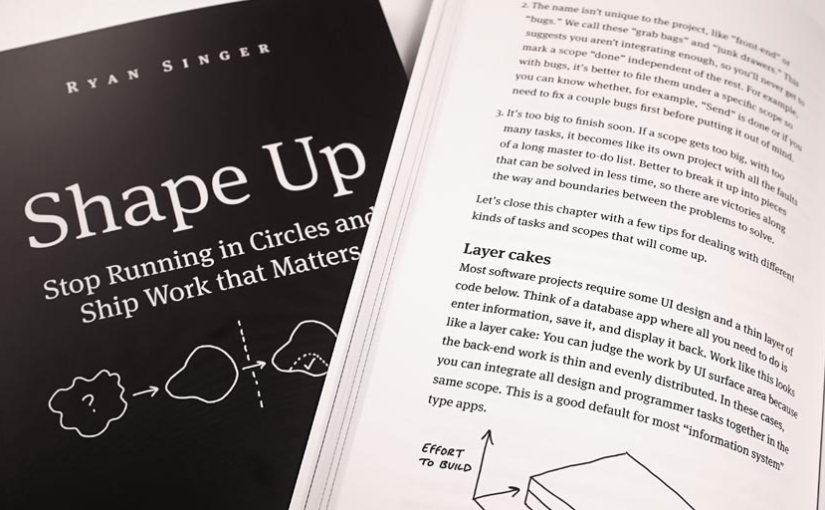
Book Review: Shape Up: Stop Running in Circles and Ship Work that Matters

This exceedingly long-winded titled book is another Basecamp book. Basecamp is a company run by D.H.H. The OG creator of the Rails half of Ruby on Rails. As someone who primarily operates in the rails universe, it seemed only right to set several books from Basecamp and DHH into my reading list. However, I found this book to be slightly disappointing. 

With a dozen and half different project management designs, from Waterfall, Kanban, and Scrum, this book describes their version of how to tackle projects that were detailed and clear. Yet the process they use, however effectively just feels like a small cycle waterfall with an emphasis on team ownership. 

The concept of shaping work before you start doing the work is a solid idea. The general idea is that you would make some rough designs and sketch out the functionality you are about to do, to properly shape the work. There are 3 main stages of shaped work: 

  1. The initial design is rough 
  2. The problem has been solved and well thought out, with any questions resolved
  3. It is bounded in scope and that scope is locked. 

Another aspect of Shape that I can get behind is Breadboarding which is a way to sketch out a flow for a solution to a problem, showing all the critical parts of the problem without being affected by the final design. Function over Form. 

The big problem I have with shape-up is the weird relationship when it comes to teams. They layout that there are essentially two different teams, one that decides what to solve and designs a solution, then there is another team that essentially implements whatever is written into the project. The removal of collaboration of the implementors and the planners on a project seems extremely dangerous. 

So, in summary, I wouldn’t recommend the overall process that Singer recommends in Shape Up, but there were still some tidbits of wisdom within. I don’t recommend reading this one.

Book Review: Drive – Daniel H. Pink

Most of what we know about motivation is wrong. Dan Pink dives into what it is that truly motivates us and how motivation has changed over the years. He states that there are two types of motivation: Intrinsic and Extrinsic. Intrinsic motivation is the behavior that drives us internally, such as happiness, personal fulfillment and meaning. Extrinsic motivation is driven by external factors, such as money, recognition, or other materialistic rewards.

Intrinsic Motivation has three parts: Autonomy, Mastery and Purpose. Autonomy is control over your life, your work, and how you accomplish different tasks in your life. Mastery is the ever growing pursuit of knowledge in your craft, the challenge set forth by oneself to constantly improve and be the best. Purpose is the desire to do something that actually matters and might leave a positive impact in the world.

Dan then goes on to explain how the newer age motivation what he called Motivation 2.0 is no longer extrinsically driven after a certain point. People are more likely to take lower positions or less income in order to have more control over their life. Have time flexibility to be with family, to be more in control of their work and to work on projects that actually matter to them.

Overall the book was an interesting read into how the new wave of professionals will be motivated in the workforce and how they will put more value on intrinsic aspects of a job than just a high salary. People want to make a difference, they want to feel like what they do matters, and that they themselves matter. It is a good idea to do some introspection. Does your job make you happy, do you feel like you matter, and do you think you are making a positive impact in your workplace or your world.

This was my first book in my 2022 reading list. If you want to see what else is on my list feel free to check out that blog post: https://blog.p3rishable.com/2021/12/27/10-rule-my-reading-list-for-2022/